Ask AI About U-Pull-&-Pay
Find a Local Junkyard
ALABAMA
ARIZONA
COLORADO
FLORIDA
GEORGIA
INDIANA
KENTUCKY
LOUISIANA
MISSISSIPPI
NEW MEXICO
NORTH CAROLINA
OHIO
PENNSYLVANIA
SOUTH CAROLINA
TENNESSEE
TEXAS
How to Buy a Budget Used Car in Colorado: Emissions, Registration, and Real Value
U-Pull-&-Pay | Jun 6, 2026
The fastest way to blow your budget on a used car in Colorado is to focus on the sticker price and leave emissions and paperwork for "later." A cheap car that can't pass an emissions test, or that comes with a title problem you didn't catch, stops being cheap in a hurry. The good news is that almost every one of those surprises is avoidable when you know what to check before you hand over any money.
This guide walks you through buying a budget used car in Colorado the practical way: confirm what the state requires, line up your paperwork, and judge a car's real value before you commit. It's written for first-time buyers, people new to Colorado, and anyone shopping on a tight budget who wants a dependable vehicle without unexpected costs after the sale.
The short version: the smartest move is to verify emissions and title status before you pay, not after. Do that, and the rest of the process is mostly about staying organized.
Before you buy a budget used car in Colorado: a quick checklist
Run through these steps in order. Most of them cost nothing and can save you from buying a car you can't register.
- Find out whether the car needs an emissions test for your county, and ask the seller for a current passing certificate if one is required.
- Confirm the title is clean and in the seller's name, with no "salvage," "junk," or "parts only" branding unless you fully understand what that means.
- Check the vehicle identification number (VIN) on the car against the VIN on the title.
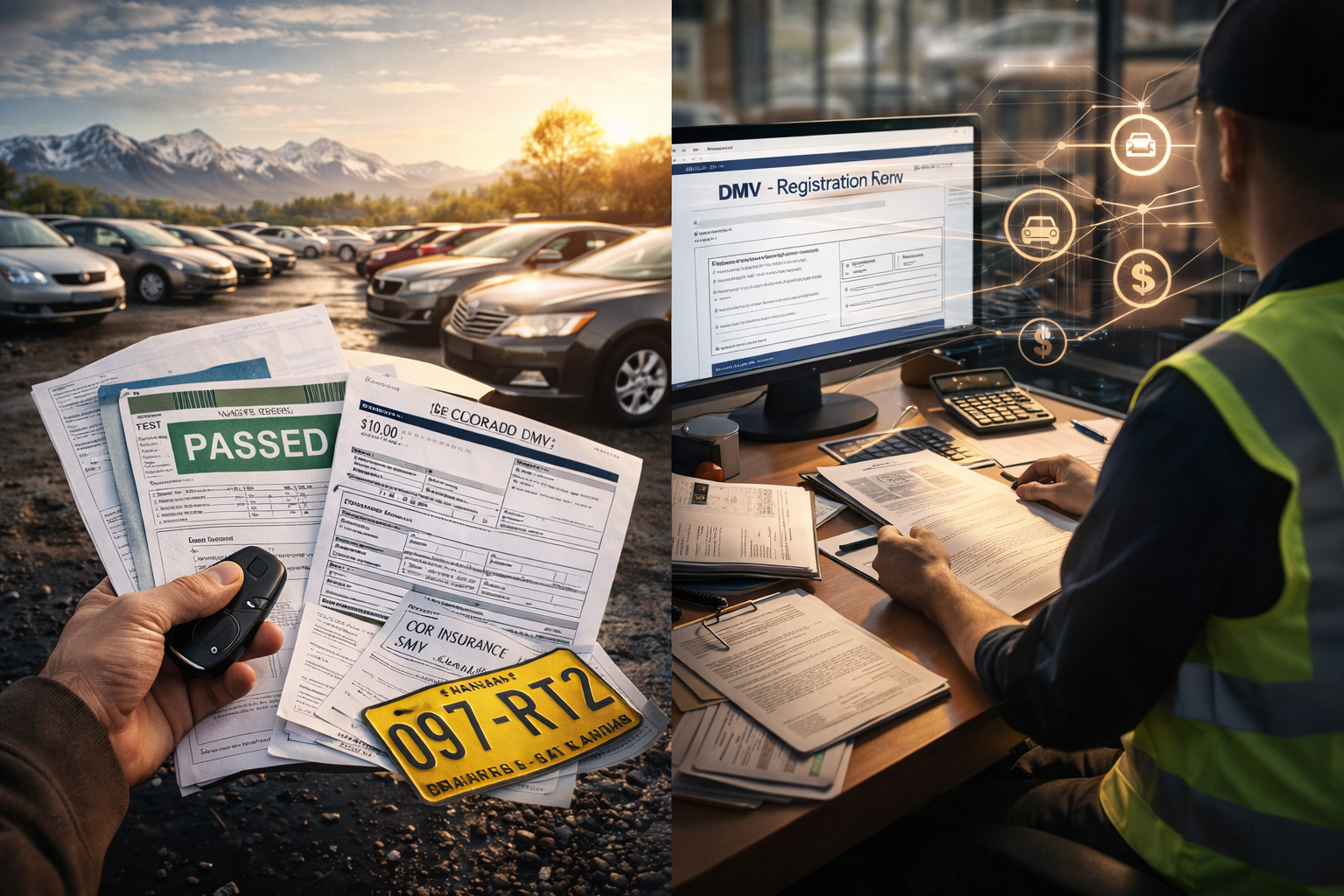
- Gather the documents you'll need: the signed title, proof of Colorado insurance, an emissions certificate if required, and a bill of sale.
- Budget for registration fees, which vary by the vehicle's age, weight, and your county of residence.
- Plan for a pre-purchase inspection by a mechanic you trust.
Handle these essentials upfront and you protect your budget from the expenses that catch most buyers off guard.
Does a used car need to pass emissions in Colorado?
It depends on where you live. Colorado does not test every vehicle statewide. Emissions testing is required mainly in the Front Range program area, which includes Boulder, Broomfield, Denver, Douglas, and Jefferson counties, plus parts of Adams, Arapahoe, Larimer, and Weld counties. If you live outside the program area, your car likely doesn't need a test at all. If you live inside it, an emissions test is usually a gatekeeper to registration.
A few rules matter most for budget shoppers, since older cars are exactly the ones that get tested:
- New vehicles are generally exempt from emissions testing for their first seven model years, so most budget used cars are past that exemption and will need a test in a program county.
- When a vehicle is sold in an emissions area, the seller is typically responsible for providing the buyer a current passing emissions certificate. Ask for it as a condition of the sale.
- Testing frequency and fees depend on the vehicle's age and fuel type, and the rules change over time.
Because the details shift and county boundaries within the program area can be confusing, confirm what applies to your specific car and address using the state's official guidance. The Colorado Division of Motor Vehicles explains current requirements on its vehicle emissions page. If a car you're eyeing has a recent failed test or is missing emissions equipment, treat that as a real cost, not a minor detail.
Titling and registering your used car in Colorado
Once you've found the right car, titling and registration are the next steps. In a private-party sale, you are responsible for transferring ownership through your county motor vehicle office, so understanding the sequence keeps you from making a second trip.
Plan to bring the following to your county office, where appointments are often required:
- The original Certificate of Title, signed over to you by the seller, with the odometer reading completed.
- Proof of Colorado insurance for the vehicle.
- A bill of sale showing the price, date, VIN, and both parties' names (recommended, and required if the price isn't listed on the title).
- A passing emissions certificate if your county requires one.
- Payment for the title transfer fee, registration fees, and any taxes due.
A couple of points trip people up. In Colorado you generally have a limited window after purchase to register the vehicle before late fees apply, so don't sit on the paperwork. License plates belong to the owner, not the vehicle, which means the seller keeps their plates and you'll get new ones or a temporary registration. Because counties operate independently, hours, appointment rules, and accepted documents can vary. Confirm the current process for your county through the state's official buying and selling a vehicle page before you go. This is general information, not legal advice, so verify anything specific to your situation with the DMV or your county office.
Look past the sticker price: how to judge real value
A low price only tells you part of the story. The cars that turn out to be true bargains are the ones that pass a careful look. Before you buy, weigh the full picture:
- Maintenance history: records of oil changes, timing belt service, and major repairs signal how the car was cared for.
- Wear items: check the condition of brakes, tires, belts, and the battery, since several of these due at once add up fast.
- A vehicle history report: look for past accidents, title brands, and odometer inconsistencies.
- A pre-purchase inspection: an hour with a trusted mechanic can reveal problems a test drive won't.
- Total cost to own: factor in fuel efficiency, insurance, and likely repairs, not just the asking price.
Upcoming repairs don't have to be a dealbreaker. One reason an older, affordable car can still make financial sense is that you can keep it on the road cheaply by sourcing your own parts. For many common components, pulling the part yourself at a self-service junkyard in Denver costs a fraction of buying new or paying full retail labor. If you go that route, verify the year, make, model, trim, engine, and interchange details so the part actually fits, and remember that yard inventory changes constantly, so check current availability before you drive out.
Watch out for salvage and "parts only" titles
Branded titles are where some "great deals" fall apart. A salvage title means an insurer declared the vehicle a total loss, and a salvage vehicle cannot legally be driven on the road until it has been repaired, inspected, and reissued as a "rebuilt from salvage" title. Vehicles labeled "junk," "parts only," or "for crusher" cannot be titled in Colorado at all and can only be used to supply parts for another car.
None of this means a branded-title car is automatically a bad buy, but it changes what you're getting and what it's worth. If a seller is vague about the title status or the price seems too good to be true, slow down and confirm exactly what the title says before any money changes hands.
First-time buyer playbook
If this is your first used-car purchase, a little structure goes a long way:
- Do your homework: learn the typical price range for the make, model, and year you want so you can spot a fair deal.
- Set a realistic total budget: include registration, insurance, an emissions test if required, and a repair cushion, not just the purchase price.
- Be ready to negotiate: knowing market prices gives you leverage, and visible issues are fair grounds to ask for less.
- Inspect before you commit: a pre-purchase inspection is cheap insurance against an expensive mistake.
- Take an active role: understanding a car's history and condition yourself, rather than relying on a seller's description, is where real savings come from.
If you'd rather skip the private-party hunt, you can also shop for affordable used cars at U-Pull-&-Pay, where vehicles are priced for budget-minded buyers. As with any used car, "affordable" doesn't mean perfect, so the same inspection and paperwork checks still apply, and inventory changes often.
When a budget car isn't the right call
Sometimes the math points the other way. If you're replacing a current vehicle that needs more in repairs than it's worth, putting that money toward a sounder used car often makes more sense than chasing one more fix. And if the old car is truly done, you don't have to let it sit in the driveway. You can sell an old car for a cash offer and put the proceeds toward your next vehicle, instead of paying to keep it registered and insured while it goes unused.
Buy with confidence, not surprises
Buying a budget used car in Colorado comes down to a simple habit: confirm the emissions and title situation before you pay, line up your paperwork, and judge the car on its real condition rather than its price tag. Do that, and an inexpensive car can become genuinely reliable, affordable transportation rather than a source of regret. When you're ready to start shopping, compare your options, lean on official state resources for emissions and registration questions, and take the hands-on approach that keeps you in control of the outcome.