Ask AI About U-Pull-&-Pay
Find a Local Junkyard
ALABAMA
ARIZONA
COLORADO
FLORIDA
GEORGIA
INDIANA
KENTUCKY
LOUISIANA
MISSISSIPPI
NEW MEXICO
NORTH CAROLINA
OHIO
PENNSYLVANIA
SOUTH CAROLINA
TENNESSEE
TEXAS
How to Save Money on Auto Repairs with DIY and Used Parts
U-Pull-&-Pay | Dec 6, 2025
Auto repair bills have a way of showing up at the worst possible moment, and the labor charge is often the part that stings the most. A job that takes an hour of shop time can cost more in labor than the part itself, especially on routine fixes that a careful owner can handle in a driveway. If you're tired of watching repair estimates climb, doing some of the work yourself and sourcing parts from a self-service salvage yard is one of the most reliable ways to bring the total down.
This guide explains how DIY repairs and used auto parts actually save money, which jobs are realistic to tackle on your own, how to find a part that fits, and how to know when a repair stops being worth it. By the end, you'll be able to decide which approach makes sense for your vehicle and your comfort level, even if you never set foot in a yard.
Why DIY Repairs and Used Parts Cut Costs
Two things drive most repair invoices: labor and parts markup. When you do the work yourself, you eliminate the labor line entirely. When you buy a used part instead of a new one from a dealership or parts counter, you skip the retail markup that comes with new inventory. Stack those savings together and a repair that would have cost several hundred dollars at a shop can sometimes be done for the price of the part and a little of your time.
Used parts make the most sense for components that don't wear out the way consumables do. Body panels, mirrors, headlight and taillight assemblies, interior trim, window regulators, alternators, starters, and similar pieces can often be reused with no meaningful loss in function. Items that wear with use or are safety-critical, such as brake friction surfaces, belts, filters, and fluids, are usually better bought new. A used part also won't carry a new-part warranty, so it helps to weigh the savings against the small chance you'll need to replace it again later.
Which Repairs Are Realistic to Do Yourself
The honest answer is that it depends on your tools, your space, and your willingness to learn. Plenty of common repairs are well within reach for a patient beginner with basic hand tools and a free afternoon. Others involve safety systems, special equipment, or real physical risk and are better left to a professional.
Jobs that many owners can handle at home include:
- Replacing brake pads on a vehicle you're comfortable lifting and supporting safely
- Swapping a battery, alternator, or starter
- Changing headlight and taillight assemblies, bulbs, and fuses
- Replacing air and cabin filters, wiper blades, and spark plugs
- Installing used body panels, mirrors, door handles, or interior trim
Repairs that are usually worth leaving to a shop include anything involving airbags or other supplemental restraint components, air-conditioning refrigerant work, internal transmission repair, timing components on many engines, and any job that requires specialized tools or puts you under a vehicle that isn't properly supported. If a repair makes you uneasy, that instinct is worth respecting. A botched safety repair can cost far more than the labor you were trying to save.
How a Self-Service Salvage Yard Works
A self-service yard runs on a simple idea: you find the part, you pull the part, and you pay a price that reflects the savings of doing the work yourself. The vehicles are organized so you can locate the one you need, and you bring your own tools to remove the component. Because there's no labor cost baked in, prices tend to be a fraction of what a new part would run.
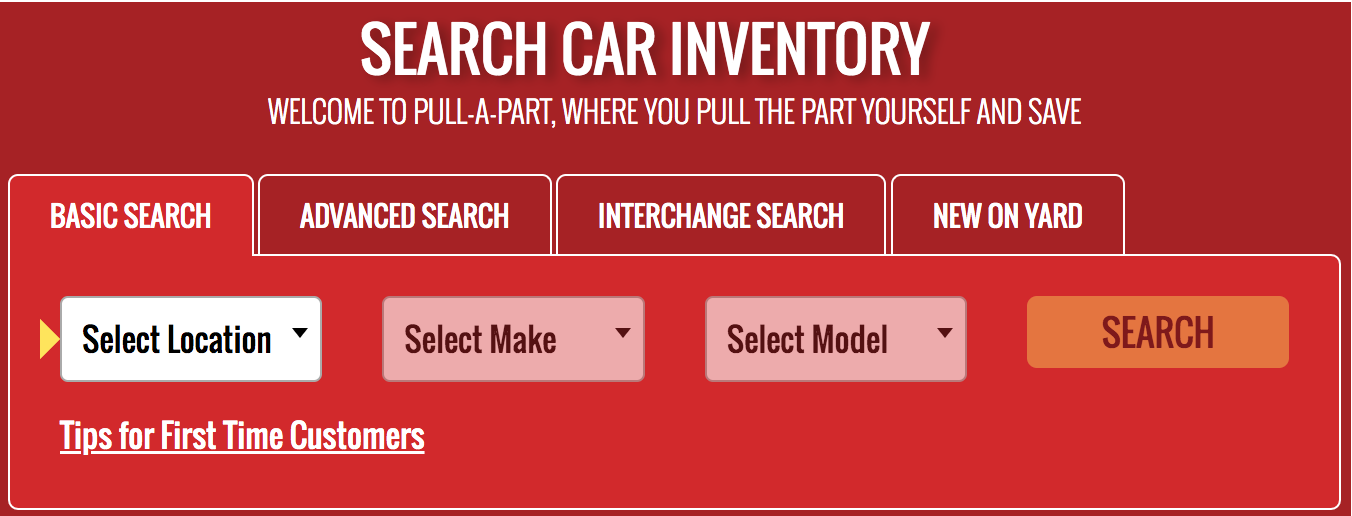
U-Pull-&-Pay operates this way, and you can find a self-service U-Pull-&-Pay location near you where the inventory of cars, trucks, and SUVs is updated regularly and can be searched online before you drive out. That last point matters: inventory at any salvage yard changes constantly as vehicles arrive and get picked over, so checking the current online listing first saves you a wasted trip. If the vehicle you need isn't on the lot yet, many locations let you set up a free alert and be notified when a matching year, make, and model arrives.
How to Find a Used Part That Actually Fits
The biggest mistake DIYers make at a yard is grabbing a part that looks right but doesn't match. Fitment depends on more than the badge on the bumper. Before you commit to a part, confirm the details and verify compatibility rather than assuming.
Work through this short checklist before you pull anything:
- Confirm your vehicle's exact year, make, model, trim, and engine. A small difference in engine or trim can change which part fits.
- Use a parts interchange or compatibility tool to see which other vehicles share the same component. The donor car doesn't always have to match yours exactly.
- Bring your old part with you when possible so you can compare connectors, mounting points, and dimensions side by side.
- Inspect the used part for damage, cracks, corrosion, or excessive wear before you remove it.
- Check the current online inventory before you leave home, and set an alert if the vehicle you need isn't in stock yet.
No yard can guarantee that a used part will fit every vehicle, which is exactly why verifying year, make, model, trim, engine, and interchange information ahead of time is worth the few minutes it takes.
What to Bring to the Yard
Come prepared so you're not improvising in the lot. Bring the hand tools the job requires, gloves, a flashlight, something to carry parts in, and a measuring tape or your old component for comparison. Wear closed-toe shoes and clothes you don't mind getting dirty. A little preparation turns a frustrating visit into a quick, productive one.
When a Repair Isn't Worth It
DIY and used parts can rescue a lot of vehicles, but not every car is worth saving. A useful rule of thumb is to compare the cost of the repair to the car's current value and its likely future reliability. If a single repair approaches or exceeds what the vehicle is worth, or if you're facing a string of major repairs in a row, it may be time to consider a different path.
At that point you generally have two practical options. One is to replace the vehicle without overspending by shopping for a quality, affordable used car, keeping in mind that "affordable" doesn't mean flawless and any used vehicle should be inspected for your specific needs. The other is to sell your junk car for cash rather than letting it sit and depreciate, since even a non-running car has scrap and parts value.
If you do sell or dispose of a vehicle, handle the paperwork correctly so you're not held responsible for a car you no longer own. Title transfer, releasing liability, and notice-of-sale or notice-of-transfer requirements vary from state to state, and so do rules for canceling registration and surrendering or transferring license plates. Confirm the current process with your state's motor vehicle agency, which may be called the DMV, BMV, MVD, Department of Revenue, Secretary of State, or another name depending on where you live. This is general information, not legal advice.
Tips to Get the Most Out of Every Repair
A few habits make DIY repairs go more smoothly and stretch your savings further:
- Diagnose carefully before buying anything. Replacing the wrong part is the fastest way to lose the money you saved.
- Watch a reputable repair walkthrough for your specific year, make, and model before you start.
- Buy consumable wear items new and save the used-part hunting for durable components.
- Keep your old part until the new one is installed and confirmed working.
- Know your limits, and don't gamble on a safety-critical repair you're not equipped to do correctly.
The Bottom Line
Cutting auto repair costs comes down to two levers you control: doing the labor yourself and sourcing the right used parts at the right price. For drivers willing to put in a little effort, the savings add up quickly, and the confidence that comes from understanding your own vehicle is a bonus that lasts. Match the job to your skill level, verify fitment before you buy, and be honest about when a car is worth fixing. When a self-service approach fits the situation, U-Pull-&-Pay gives you a straightforward way to find the parts you need and keep more money in your pocket.